

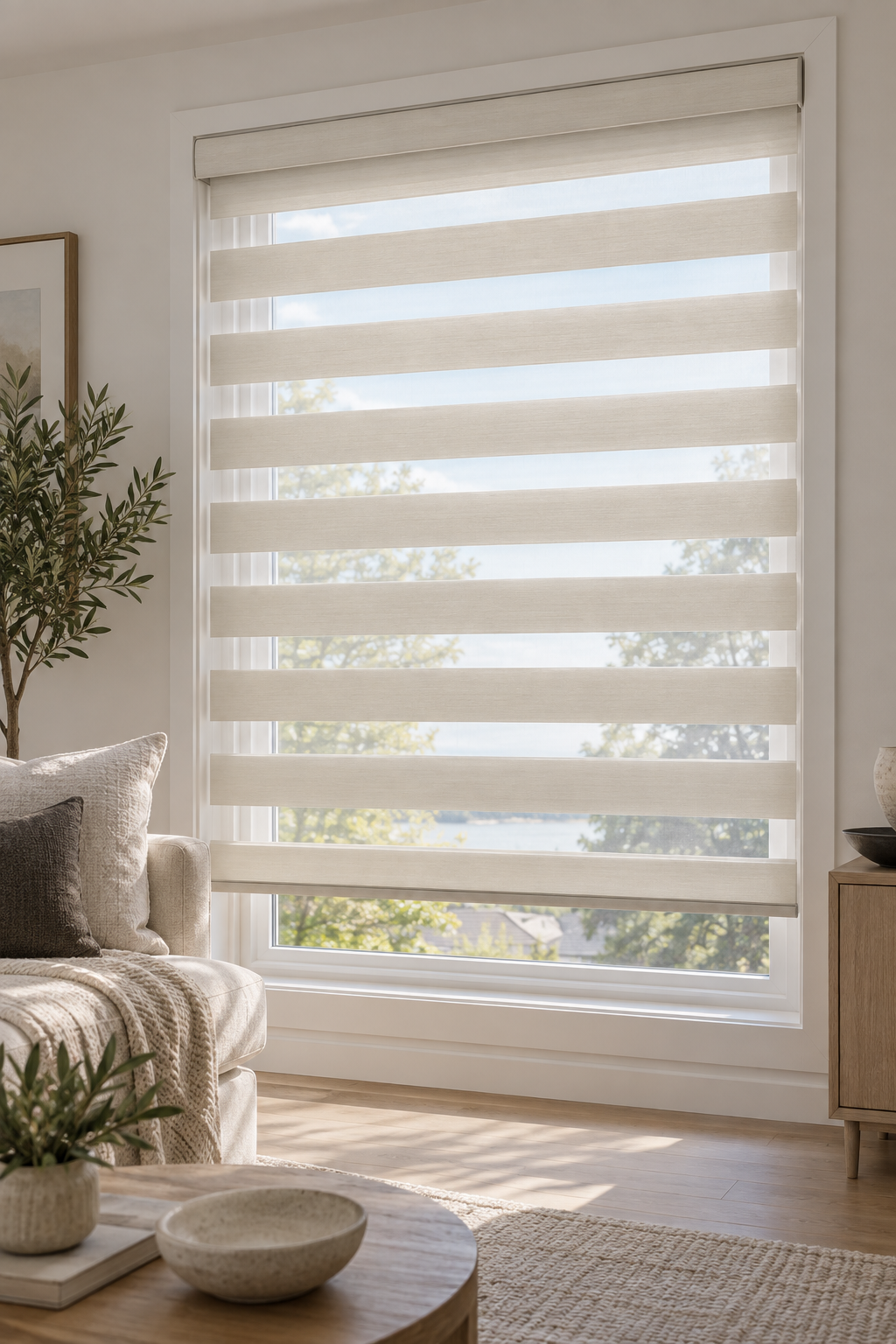
The best material for Venetian blinds depends on the room, window, and way you use the covering. Real wood offers a warm, structured appearance. Faux wood provides wood-inspired styling with different care considerations, while aluminium may suit buyers comparing lighter, more contemporary slats.
There is no universal winner. Consider moisture, appearance, cleaning, weight, window size, operating frequency, privacy, light control, mounting, and installation before choosing blinds for your Oakville or Greater Toronto Area home, condo, or office.
Quick summary

- Choose real wood when natural appearance and structured styling matter, provided the room and care routine suit the product.
- Consider faux wood when you want a wood-inspired look and need to compare finish, weight, cleaning, and room suitability.
- Ask about aluminium when weight, finish, or a slimmer contemporary appearance matters. Confirm availability and specifications before ordering.
- Material alone does not guarantee blackout or complete privacy. Slat angle, fit, mounting, opacity, and window conditions also affect performance.
- Professional measurement is particularly useful for oversized, unusual, or difficult-to-access windows.
Wood, faux wood, or aluminium: what changes?
Venetian blinds use horizontal slats that tilt to adjust daylight and privacy. The material affects visual character, handling, cleaning, and room suitability, but it is only one part of the finished result.
Lavish Blinds verifies Venetian blinds and wooden and faux-wood options among its made-to-measure window coverings. Aluminium is included here as a comparison category to investigate, not as a confirmed Lavish Blinds offering. Ask which materials, finishes, slat sizes, and operating systems are available for your project.
Before choosing a finish from a sample alone, use this custom blinds buying guide to compare material, room suitability, care, operation, mounting, and installation.
Venetian blind materials compared

| Criterion | Real wood | Faux wood | Aluminium |
|---|---|---|---|
| Appearance | Natural grain and a warm, structured look. | Wood-inspired styling with varied finishes. | Streamlined or contemporary, depending on finish and slat size. |
| Room conditions | Confirm whether the product and finish suit moisture exposure. | Confirm suitability instead of assuming it is waterproof. | Ask how the selected finish should be used and maintained. |
| Weight | Assess dimensions, slat size, headrail, and operating hardware. | Confirm the finished blind’s weight and required hardware. | May be worth investigating where weight is important, but assess the complete system. |
| Cleaning | Use cautious, material-specific care. | Follow the exact product instructions. | Clean without bending slats or forcing components. |
| Best question | Does the appearance justify the care and room requirements? | Does this product provide the look, weight, and care routine I want? | Is it available and suitable for my window and room? |
Real wooden Venetian blinds
Real wood can complement flooring, furniture, trim, or a classic interior. Its natural visual character gives the window a warm, coordinated appearance while retaining the familiar Venetian method of adjusting light and privacy.
The tradeoff is that material, finish, window size, and room conditions must be considered together. Ask how the product should be maintained, whether the room exposes it to moisture, how much the completed blind will weigh, and whether the operating hardware suits the window.
Real wood is not automatically suitable or unsuitable for a particular room. The decision depends on product instructions, moisture conditions, window position, and the care routine you can provide. If you choose it, the wooden blinds care guide explains why real wood and faux wood should not automatically be cleaned alike.
Faux-wood Venetian blinds
Faux wood may suit buyers seeking wood-inspired styling while comparing practical requirements for family rooms, offices, busy spaces, or frequently adjusted windows. The specific product, finish, weight, and care instructions still matter.
Do not choose faux wood solely because it sounds practical or moisture-friendly. Ask what it is made of, where it is suitable, how it should be cleaned, how much it weighs at the required size, and whether the finish suits the décor.
Slat width changes the visual result and how the blind relates to trim, handles, and furniture. Discuss the finished appearance when open, closed, and tilted. This preparation resource for faux-wood blinds installation can help identify questions about hardware and installation conditions.
Aluminium Venetian blinds: what to confirm
Aluminium is worth investigating when a lighter-looking, contemporary slat style or particular finish is important. Availability, construction, controls, and room suitability vary, so confirm the exact product rather than assuming it is available from every supplier.
Ask whether it suits the window’s size and operating frequency. Confirm how the slats respond to handling, how the finish should be cleaned, which colours are available, and how the headrail and brackets will sit in the opening.
Which material fits different rooms?
Kitchens and bathrooms
Moisture makes product-specific guidance essential. Ask whether the material and finish suit the room, how marks should be cleaned, and which parts must remain dry. Do not assume either wood or faux wood suits every wet area.
Bedrooms
Privacy and controlled light may be priorities, but material alone does not create blackout conditions. Review fit, mounting, slat adjustment, and side gaps. If stronger darkening is needed, compare Venetian blinds with blackout shades or roller blinds.
Living rooms and offices
Appearance and daily operation often carry equal weight. Consider how often the blind will be tilted, raised, lowered, and cleaned, especially near furniture, children, pets, or frequently used doors.
Large or awkward windows
Width, weight, stacking space, and operating frequency can affect the choice. Professional assessment is useful for oversized windows, skylights, bay windows, sliding doors, inconsistent openings, and windows near built-in furniture.
Material is only one part of privacy and light control
Light and privacy depend on slat angle, overlap, window orientation, mounting position, side gaps, top gaps, and surrounding conditions as well as material.
For bedrooms or rooms where glare and darkness matter, ask how the proposed blind will perform in the actual opening. A blackout product may substantially reduce light, but no material should be treated as a guarantee of complete darkness without reviewing fit and mounting. This explanation of opacity, fit, and mounting provides useful context for related window coverings.
Why measurement and installation matter
Material selection should happen alongside measurement. Slat size, blind weight, mounting depth, headrail position, trim, handles, furniture, and operating space can affect whether the covering is practical.
Ask who confirms the final dimensions, whether an inside or outside mount is appropriate, how the blind will be installed, and what the quote includes. Lavish Blinds provides custom design and fittings, free on-site measurement and quotes, and professional installation.
Care and maintenance
Identify the exact material and finish before cleaning. Read the product documentation, begin with gentle dry dusting, and protect cords, headrails, and operating hardware from soaking or forceful handling.
Use moisture only when permitted, dry the area promptly, and stop if you notice warping, peeling, persistent staining, damaged cords, or stiff operation. Ask the supplier for product-specific guidance when documentation is unavailable.
Pre-order checklist
- Material and finish: Confirm the exact material, colour, texture, grain, sheen, and slat profile.
- Room conditions: Explain moisture, sunlight, ventilation, furniture, and frequency of use.
- Light and privacy: State whether you need daylight adjustment, glare reduction, privacy, or stronger darkening.
- Window details: Check dimensions, trim, handles, opening consistency, mounting depth, and clearance.
- Operation: Confirm raising, tilting, accessibility, and whether motorization is appropriate.
- Care and installation: Request written cleaning instructions and clarify measurement, mounting, installation scope, and warranty documentation.
- Quote: Confirm the product, controls, installation, taxes or additional charges, and inclusions.
A simple decision framework
- Start with the room: Identify moisture, sunlight, privacy, cleaning, furniture, and frequency of use.
- Choose the visual direction: Decide whether natural wood, wood-inspired styling, or a streamlined finish suits the interior.
- Check the window: Consider width, height, weight, mounting depth, handles, trim, and access.
- Set realistic expectations: Discuss fit, mounting, slat angle, opacity, and gaps rather than assuming material guarantees darkness.
- Verify the exact product: Confirm availability, specifications, care, controls, installation, and quote inclusions.
Frequently asked questions
Are wooden Venetian blinds suitable for kitchens and bathrooms?
They may be suitable in some settings, but confirm the product instructions, room conditions, and required care before ordering.
Are faux-wood Venetian blinds easier to maintain?
They have different maintenance considerations, but ease depends on the product, finish, room, and cleaning routine. Request product-specific instructions.
Do aluminium blinds provide better light control?
Not automatically. Light control depends on slat angle, overlap, fit, mounting, orientation, and gaps as well as material.
Should I choose the material before measuring?
Discuss both together. Material, slat size, weight, mounting, clearance, and operating hardware can affect the installation plan.
Choose the material that fits your room
Wood, faux wood, and aluminium should be evaluated against the actual room, care routine, window, privacy goals, and installation constraints. Confirm the specifications for the exact blind before ordering.
For a room-specific recommendation, Lavish Blinds offers personalized design consultation, free on-site measurement and quotes, and professional installation for made-to-measure window coverings in the Greater Toronto Area.