

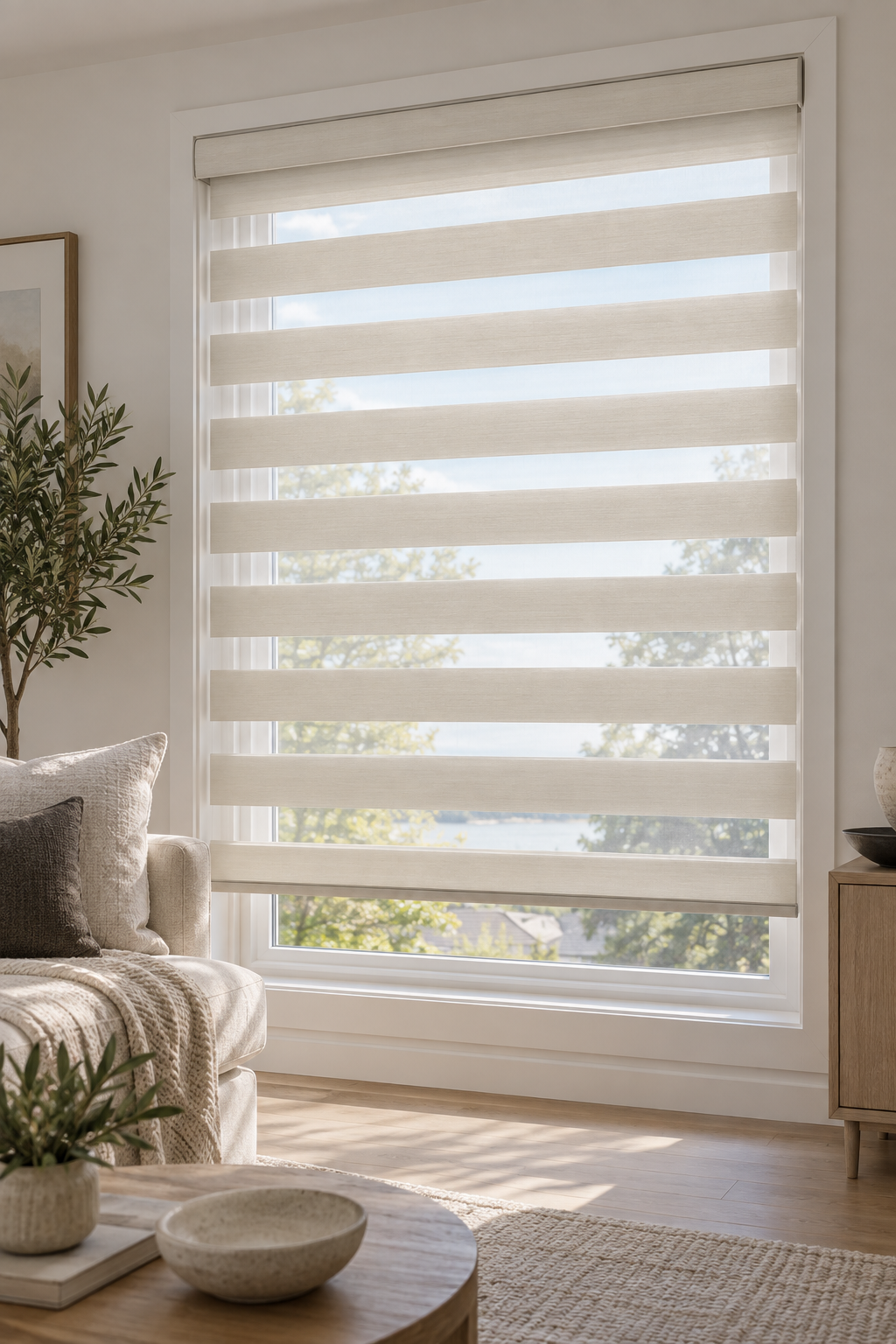
Successful faux-wood blinds installation in Toronto starts before anyone takes a measurement. First, confirm that the material suits the room, then compare it with other window coverings, document the window conditions, and identify any safety or operating requirements.
Faux-wood blinds can provide a structured, wood-inspired appearance with adjustable privacy and daylight control. The result depends on the specific product, finish, mounting method, window, and room conditions. Use the steps below to prepare a clearer brief for a professional consultation.
Quick summary

- Assess privacy, glare, daylight, moisture, cleaning, décor, and operating access before choosing faux wood.
- Compare faux wood with natural wood, roller blinds, Roman shades, blackout shades, cellular shades, and shutters where appropriate.
- Record window dimensions and surrounding obstacles, but do not rely on DIY measurements for unusual or difficult openings.
- Confirm the operating method and Canadian cord-safety requirements for the specific installation.
- After fitting, check coverage, finish, controls, slat movement, and any concerns that should be documented promptly.
Step 1: Assess what the room needs from its window blinds
Start with the room rather than the product name. Decide whether the main priority is street-facing privacy, glare reduction, adjustable daylight, a defined decorative look, easier operation, or a consistent appearance across several windows.
Consider how the room is used. A bedroom may need different light-control expectations from a living room, home office, meeting room, or kitchen. Note whether furniture sits close to the window, whether handles or walkways could interfere with the blind, and how often the covering will be adjusted.
Moisture and cleaning also deserve specific attention. Faux wood should not automatically be treated as waterproof, maintenance-free, or suitable for direct splashing. Confirm the specific material, finish, care instructions, and room suitability before ordering.
Also decide whether a slatted blind is the best format. Faux wood may suit you if you want a structured appearance and adjustable slats, but another covering may better suit a strong room-darkening requirement, a softer decorative effect, or a window that is difficult to operate manually.
Step 2: Compare faux wood with wood and other window coverings

Do not treat faux wood as the universal answer for every Toronto window. Natural wood may be preferable when genuine grain and material character are central to the design. Faux wood may be worth considering when its construction and finish suit the room, care expectations, and intended appearance.
| Decision point | What to consider | Confirm before ordering |
|---|---|---|
| Appearance | Natural wood offers genuine material character. Faux wood offers a structured, wood-inspired finish. | Colour, finish, slat style, and coordination with the room. |
| Room conditions | Both materials require consideration of moisture, condensation, heat, and location. | The product’s composition, finish, and room-specific guidance. |
| Care | Cleaning expectations vary by material and finish. | Approved cleaning methods and moisture limits. |
| Privacy and daylight | Tilting slats can adjust privacy and daylight, but gaps and mounting affect the result. | The coverage and light-control outcome you need. |
| Operation | Manual, remote-controlled, and automated operation involve different practical considerations. | Access, control method, and suitability for the window. |
| Fit | Window dimensions and mounting conditions affect appearance and operation. | Recesses, obstructions, clearances, and installation access. |
Compare wooden and faux-wood blinds with roller blinds, Roman shades, cellular shades, blackout shades, and shutters. One home or office may use different formats in different rooms while maintaining a coordinated colour or finish.
Be careful with the word “blackout.” Slatted blinds may allow light around the slats, frame, or side gaps, depending on the product and installation. If complete darkness is important, compare faux wood with blackout shades or blinds and ask what result the specific product is designed to provide.
Step 3: Document the window and surrounding space
Before the consultation, walk through each window and record conditions that could affect measurement, mounting, or operation. Your notes do not replace professional measurement, but they help the installer understand the project before arriving.
- Note the approximate width and height of each opening, including grouped windows.
- Identify the frame position, recess depth, trim, baseboards, handles, locks, and nearby walls.
- Record furniture, radiators, shelves, doors, walkways, and other obstacles.
- Flag large, high, shaped, angled, skylight, multi-panel, or difficult-to-reach windows.
- Consider where the blind should stack or sit when open, especially beside a door.
- Write down your privacy, daylight, glare, room-darkening, and cleaning priorities.
Take clear photographs if they help explain an unusual opening, but do not assume a photograph establishes final dimensions. Large or complex openings should be assessed in person so mounting and operating access can be confirmed.
Step 4: Know when professional measurement is necessary
DIY measurements may be useful as preliminary information, but they should not form the basis for ordering when a window is unusually large, high, shaped, obstructed, or difficult to reach. The same applies when several windows appear similar but have different frames, recesses, or nearby obstacles.
Small errors can affect coverage, alignment, handle clearance, and comfortable operation. Mounting position can also affect privacy and the amount of daylight entering around the edges. Avoid guessing where a professional on-site measurement can resolve the conditions directly.
Made-to-measure blinds are specified for the individual opening rather than selected as a generic standard size. Ask the installer to confirm finished dimensions, mounting approach, control position, and clearance requirements before approving the order.
Step 5: Confirm operation, access, and cord safety
Choose the operating method separately from the material decision. Manual blinds may suit an easily reached window, while remote-controlled or automated blinds may be worth discussing for high, wide, or frequently adjusted openings. Motorization describes operation. It does not automatically provide blackout, insulation, security, noise reduction, or energy performance.
Ask how controls will be accessed and whether they suit the people using the room. For motorized or smart blinds, confirm the control arrangement and project-specific requirements rather than assuming compatibility with a particular home system.
Safety must also be part of the conversation. Health Canada recommends avoiding window coverings with long accessible cords because of strangulation risks. Its industry guidance states that reachable cords must meet specified length and loop limits after installation. Review the official Canadian window-covering safety guidance and ask which compliant operating method applies.
Step 6: Prepare for the on-site consultation and quote
Bring your room priorities and window notes to the consultation. Include preferred colours or finishes, photographs of difficult windows, furniture and access concerns, and questions about material, care, privacy, daylight, operation, mounting, installation, and aftercare.
Ask the provider to explain the specific faux-wood product rather than relying on broad assumptions. Confirm the material and finish, cleaning method, room suitability, operation, and what the quote includes.
Before approving the order, ensure the quote identifies the rooms and openings covered, selected products and finishes, operating method, installation expectations, and aftercare or warranty information.
Step 7: Check the finished installation before signing off
Inspect the installation while the installer is present, or as soon as possible afterwards. Look at each window from inside the room and from the usual viewing position. The blinds should sit as expected, cover the intended area, and coordinate with adjacent windows where requested.
- Operate each blind and check that the slats tilt or move as expected.
- Test remote controls or automated functions included in the order.
- Check privacy and daylight adjustment against the original room brief.
- Look for damage, marks, uneven finishes, loose components, or unexpected contact with nearby surfaces.
- Confirm that handles, furniture, doors, and walkways remain practical to use.
- Check that operating components are positioned as discussed and do not create an accessible hazard.
- Keep the quote, product details, installation information, and warranty documents together.
If a blind does not fit, operate, or finish as expected, photograph the concern and report it promptly. Review the provider’s post-installation checks and warranty information to help distinguish a product concern from an installation or workmanship concern.
After installation, also check coverage, alignment, slat movement, controls, privacy, daylight adjustment, finish quality, clearances, and operating components. Keep the quote and installation records and report concerns promptly.
Frequently asked questions
Are faux-wood blinds suitable for every room in a Toronto home or office?
No. Suitability depends on the material and finish, moisture exposure, cleaning expectations, privacy and daylight requirements, window dimensions, and operating access. Confirm room guidance before ordering, particularly in areas exposed to splashes, condensation, or heat.
Should I measure my windows myself before booking installation?
You can record approximate dimensions and surrounding conditions, but do not rely on DIY measurements for large, high, shaped, obstructed, or difficult-to-reach windows. Professional measurement helps confirm fit, mounting, coverage, and operation.
Can faux-wood blinds provide complete blackout?
Not necessarily. Light can enter through slat gaps, side gaps, or around the frame, depending on the product and installation. If complete darkness matters, compare faux wood with blackout shades or blinds and ask about the expected result for your window.
What should I ask about cord safety before installation?
Ask which operating method will be installed, whether the product has accessible cords or loops, and how it meets applicable Canadian requirements. Health Canada recommends avoiding long accessible cords, so confirm the details for the selected product.
Lavish Blinds: Prepare the brief before you book installation
Faux-wood blinds may suit Toronto-area homeowners, condo owners, and office managers who want a structured, wood-inspired appearance with adjustable privacy and daylight control. The right decision depends on bringing the material, room conditions, window dimensions, mounting, operation, care, and safety requirements together.
Prepare your room priorities, window notes, access concerns, and questions before the consultation. Let the final product choice and dimensions be confirmed through an on-site assessment rather than assumptions based on a standard size.
Lavish Blinds describes a consultative process that includes personalized design guidance, free on-site measurement and quotes, made-to-measure blinds, shades and shutters, and professional installation. Its range includes wooden and faux-wood blinds, roller, Venetian, vertical, Roman, cellular, blackout, shutter, motorized, and smart blind options. For personalized design guidance, a free on-site measurement and quote, and professional installation, contact Lavish Blinds about your Toronto-area window-covering project. Additional information is available about faux-wood blind considerations, window blind material comparisons, and post-installation blinds checks. Confirm project-specific pricing, specifications, timing, and warranty information in the quote.