

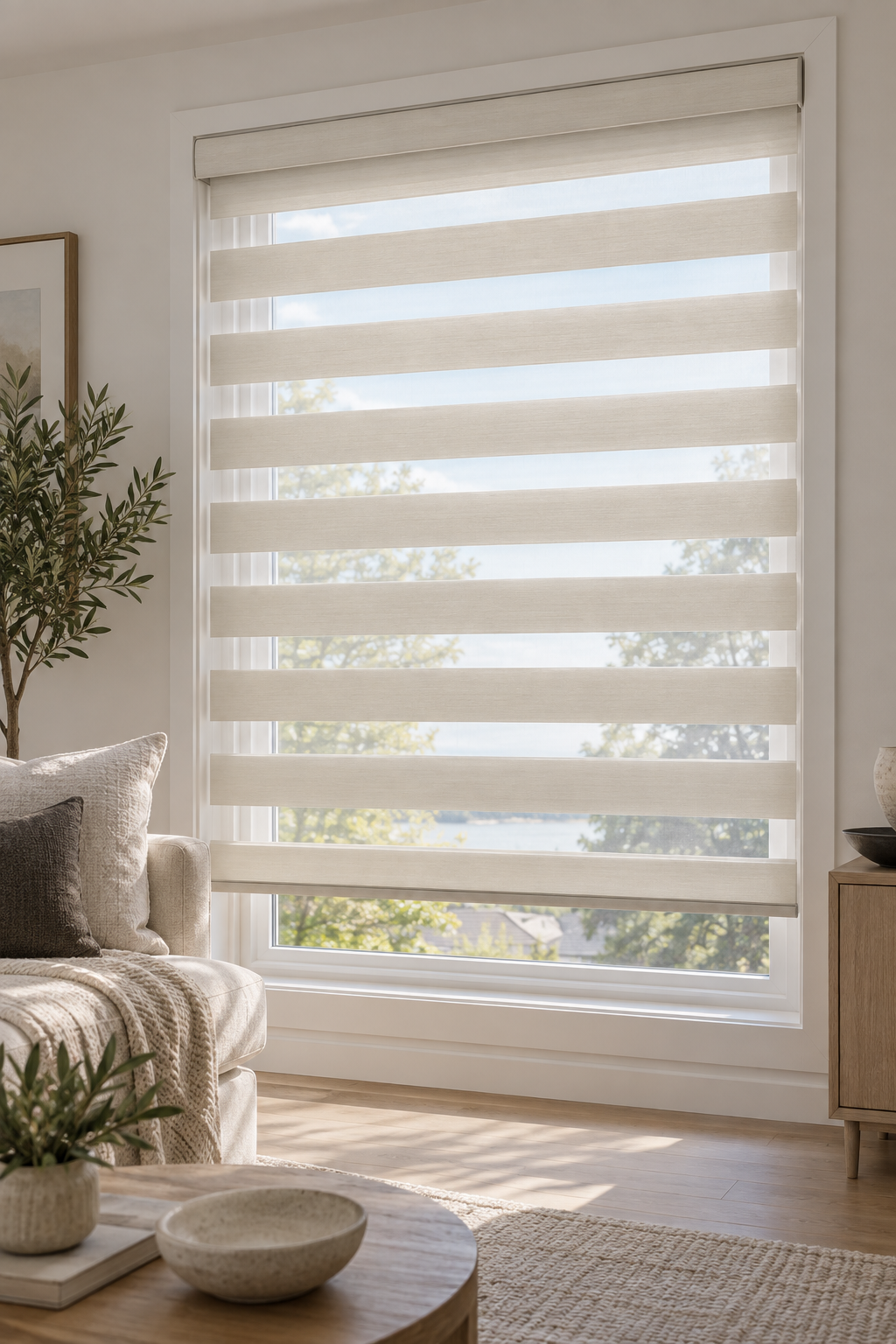
Custom shutters can work well for irregular windows, but they are not automatically the best choice for every unusual opening. The right decision depends on the window’s shape, frame depth, panel movement, mounting position, clearance, access, and the room’s priorities.
Instead of choosing a treatment for the property as a whole, assess each window individually. An arched window, bay window, skylight, large opening, or angled section may need a different solution from a standard rectangular window in the same room.
Quick summary

- Custom shutters may suit homeowners who want a structured appearance, adjustable privacy, controlled daylight, and a tailored fit.
- Check frame depth, angles, trim, handles, furniture, adjoining windows, panel movement, and access before choosing shutters.
- Compare shutters with roller blinds, blackout shades, cellular shades, Roman shades, Venetian blinds, and faux-wood blinds based on the room’s actual priorities.
- DIY measurements are useful for planning, but unusual geometry or restricted access makes professional on-site measurement especially valuable.
When custom shutters make sense for irregular windows
Custom shutters may be a strong candidate when you want an architectural, structured look rather than a soft fabric treatment. They can also suit rooms where adjustable privacy and controlled daylight matter, provided the panels, frame, and mounting position work with the window.
The key question is not whether shutters can look attractive on an unusual window. It is whether the complete installation can operate comfortably and provide the level of privacy and light control you need. The window shape, configuration, clearance, and installation plan all matter. These custom shutter selection tips provide a useful framework for reviewing those considerations.
Irregular windows are rarely defined by width and height alone. An arch, triangle, angled bay, deep recess, skylight, or unusually large opening may affect where a treatment can mount and how it can move. Handles, trim, sills, furniture, and nearby doors can create additional restrictions.
Shutters are therefore worth considering when their structure supports the window and the way you use the room. They may be less suitable when you need a very simple profile, stronger room darkening, softer styling, or an operating method that panels cannot provide comfortably.
Window conditions that affect shutter fit

Before comparing colours or finishes, record the conditions around the opening. For a multi-section window, treat every section as its own opening rather than measuring the entire feature as one unit.
- Shape: Note whether the window is arched, triangular, angled, round, sloped, or otherwise non-standard.
- Configuration: Identify separate sections, meeting points, corner angles, and whether adjacent panels could interfere with one another.
- Frame and trim: Check the recess depth, casing, sill, uneven surfaces, and any space available for mounting hardware.
- Obstructions: Record handles, locks, screens, radiators, furniture, shelving, light fixtures, and nearby doors.
- Movement: Consider how each panel would open, fold, tilt, stack, or otherwise move in relation to the room.
- Access: Note high windows, skylights, narrow work areas, ladders, and furniture that could complicate installation or daily adjustment.
- Window use: Decide whether the window must remain easy to open for ventilation, cleaning, or access.
Bay windows are a useful example. Each angled section may have different dimensions, obstructions, and clearance requirements. A bay window measurement checklist can help you record each section, obstruction, and access condition before professional confirmation.
These notes do not determine the final product or order dimensions. They help identify potential problems early. Product-specific deductions, mounting decisions, and clearance requirements should be confirmed for the selected treatment.
Compare shutters with other coverings before deciding
Custom shutters are only one type of custom window covering. Lavish Blinds also offers roller, Venetian, vertical, wooden, faux-wood, Roman, cellular or honeycomb, blackout, motorized, and smart options. A custom blinds buying guide can help you compare them by privacy, light control, mounting depth, operation, and room use.
| Option | May suit | Check before ordering |
|---|---|---|
| Custom shutters | Structured styling, adjustable privacy, and a tailored architectural appearance. | Frame depth, panel movement, clearance, window shape, and access. |
| Roller blinds | Clean profiles, straightforward operation, and a simple fabric surface. | Fabric opacity, mounting position, privacy, edge coverage, and clearance. |
| Blackout shades | Bedrooms or other spaces where stronger room darkening is a priority. | Fabric, mounting, side coverage, and possible light gaps. |
| Cellular or honeycomb shades | Soft coverage and a structured shade design. | Configuration, opacity, mounting depth, operation, and care. |
| Roman shades | Decorative, fabric-led interiors with a softer appearance. | Fabric, fold style, stack height, opacity, and operating access. |
| Venetian blinds | Adjustable slats and directional control over daylight and privacy. | Material, controls, headrail position, weight, and clearance. |
| Faux-wood blinds | Wood-inspired styling with adjustable slats. | Material, finish, weight, care, room suitability, and operation. |
| Motorized or smart blinds | High, wide, or difficult-to-reach windows and coordinated operation. | Controls, power, access, manual operation, and product compatibility. |
This comparison is not a ranking. It shows why an irregular window should be assessed by function as well as appearance. A shutter may provide the visual structure you want, while a roller or blackout shade may be more practical where room darkening or a compact profile matters most.
Match the treatment to the room’s priorities
Start by identifying the problem the window treatment must solve. Privacy, filtered daylight, glare control, room darkening, appearance, access, and convenient operation can point to different products.
Bedrooms and rooms needing darkness
If the main goal is a darker sleeping environment, compare shutters with blackout shades and discuss how the mounting position and edge coverage may affect light entering around the treatment. Do not assume that a shutter will provide complete blackout simply because it covers the window.
Living rooms and common areas
A living room may benefit from adjustable privacy and filtered daylight without feeling closed in. Shutters, roller blinds, Roman shades, Venetian blinds, and cellular shades can each create a different balance between structure, softness, visibility, and light control.
Offices and work areas
An office may need glare control, consistent styling across several windows, and operation that does not interfere with desks or screens. Note furniture placement and the direction of incoming light before deciding where the treatment should mount.
Condos and compact spaces
In a condo, neighbouring sightlines, balcony doors, furniture, and limited clearance can influence the decision. A treatment should preserve practical access and suit the scale of the room, not merely match a sample.
For any room, assess the complete daily routine. The best custom window coverings are those that look right, move safely, and provide the required privacy and light control without creating a new clearance problem.
Plan operation before ordering
Operation deserves attention before the product is ordered, especially for a high, wide, or hard-to-reach window. A manually operated treatment may be perfectly practical when the window is accessible and used occasionally. It may be frustrating when adjustment requires reaching behind furniture or using a ladder.
Remote-controlled, motorized, or smart blinds may be worth discussing when convenience, coordinated operation, or access is a priority. However, controls, power requirements, manual access, and product-specific compatibility should be confirmed rather than assumed.
Shutters also need a movement plan. Ask whether panels will open into the room, whether they can clear handles and furniture, and whether adjoining sections could meet or interfere at an angle. A treatment that looks excellent when closed still needs to work during cleaning, ventilation, and everyday adjustment.
Pre-measurement checklist for irregular windows
Use the following checklist to prepare for a design consultation or quote. Record what you observe, but do not convert your notes into final order dimensions without product-specific confirmation.
- Measure or record each opening separately, including the centre and side sections of a bay window.
- Describe the shape, angles, slopes, curves, and any differences between adjoining sections.
- Record frame depth, trim, casing, sill position, and the surfaces available for mounting.
- Note handles, locks, screens, radiators, furniture, shelving, doors, and other obstructions.
- Photograph the full window, each section, and the surrounding access area.
- Record whether the window needs to open for ventilation, cleaning, or access.
- Identify high areas, skylights, narrow workspaces, ladders, and restricted installation access.
- Write down the main priority: privacy, daylight, glare control, room darkening, appearance, or convenience.
- Decide whether manual, remote-controlled, motorized, or automated operation is worth discussing.
- Ask how the chosen treatment will move and what clearance it requires around the frame and room.
Observed measurements are planning information, not necessarily the dimensions used to fabricate a made-to-measure treatment. Different blinds, shades, and shutters can require different mounting approaches and deductions.
When professional on-site measurement is especially worthwhile
Professional measurement is particularly valuable when the window has unusual angles, several sections, inconsistent openings, limited clearance, restricted access, or uncertain mounting requirements. It is also sensible for skylights, very large or high windows, deep recesses, and openings near handles or built-in furniture.
An on-site assessment can consider the opening, the surrounding room, and the intended operation together. That is more useful than relying on one width and height measurement that does not show how a panel, bracket, control, or fabric treatment will function.
DIY notes can still make the consultation more productive. Bring photographs, approximate dimensions, room priorities, and details about access. The final plan should then confirm the selected product, mounting position, clearance, operation, and installation requirements.
Lavish Blinds’ service model includes personalized design guidance, free on-site measurement and quotes, and professional installation. This is useful when you want the design and fit questions addressed before approving a custom window-covering order.
Questions to ask before approving a shutter quote
- How will each panel move, and what clearance will it need?
- Where will the treatment mount, and how does that position relate to the frame, trim, and sill?
- Will the window remain operable after installation?
- How will the design address handles, furniture, radiators, adjoining sections, and angled meeting points?
- What level of privacy and daylight control should I expect in this room?
- Could light enter around the edges, and how will that be handled?
- Would roller, blackout, cellular, Roman, Venetian, faux-wood, or motorized blinds suit this opening better?
- Is manual, remote-controlled, motorized, or smart operation available for the specific product?
- Does the quote include measurement, the product, installation, hardware, and operating components?
- How will installation be completed if the window is high, narrow, or difficult to access?
Frequently asked questions
Can plantation shutters be made for arched or triangular windows?
They may be possible for some unusual shapes, but suitability depends on the specific geometry, frame, configuration, panel movement, clearance, and installation plan. Do not assume that every shape can use the same shutter design or operating method. A professional assessment can confirm what is practical for the opening.
Are custom shutters suitable for bay windows with angled sections?
They can be considered, but each section and angle must be assessed separately. Check where panels will meet, how they will open, and whether trim, furniture, or nearby windows restrict movement. Bay windows are a situation where detailed measurements and professional confirmation are especially useful.
Should I measure an irregular window myself before requesting a quote?
You can record approximate dimensions, photographs, shape, obstructions, access conditions, and room priorities to prepare for a quote. Treat those details as planning notes rather than final order specifications. Product-specific deductions and mounting decisions should be confirmed for the selected treatment.
Are shutters a good choice when an irregular window needs blackout coverage?
They may not be the strongest match if room darkening is the primary requirement. Compare shutters with blackout shades and discuss fabric, mounting, edge coverage, and possible light gaps. The right choice depends on the room’s required darkness and the window’s geometry.
What should I ask about shutter clearance around handles and furniture?
Ask where the treatment will mount, how far panels or controls will project, how they will move, and whether they can clear handles, furniture, radiators, and adjoining sections. Also confirm that the window can still be opened and that installation access is practical.
Choose for the window, not just the style
Custom shutters can be a strong solution for some irregular windows, especially when you value a structured appearance, adjustable privacy, controlled daylight, and a tailored fit. They should be selected window by window, with careful attention to shape, frame depth, panel movement, clearance, access, and daily operation.
Before committing, compare shutters with roller blinds, blackout shades, cellular shades, Roman shades, Venetian blinds, faux-wood blinds, and motorized options. The best choice is the one that satisfies the room’s practical priorities as well as its design direction.
For a made-to-measure assessment, Lavish Blinds provides personalized guidance, free on-site measurement and quotes, and professional installation for blinds, shades, and shutters in Oakville and the broader Greater Toronto Area.