

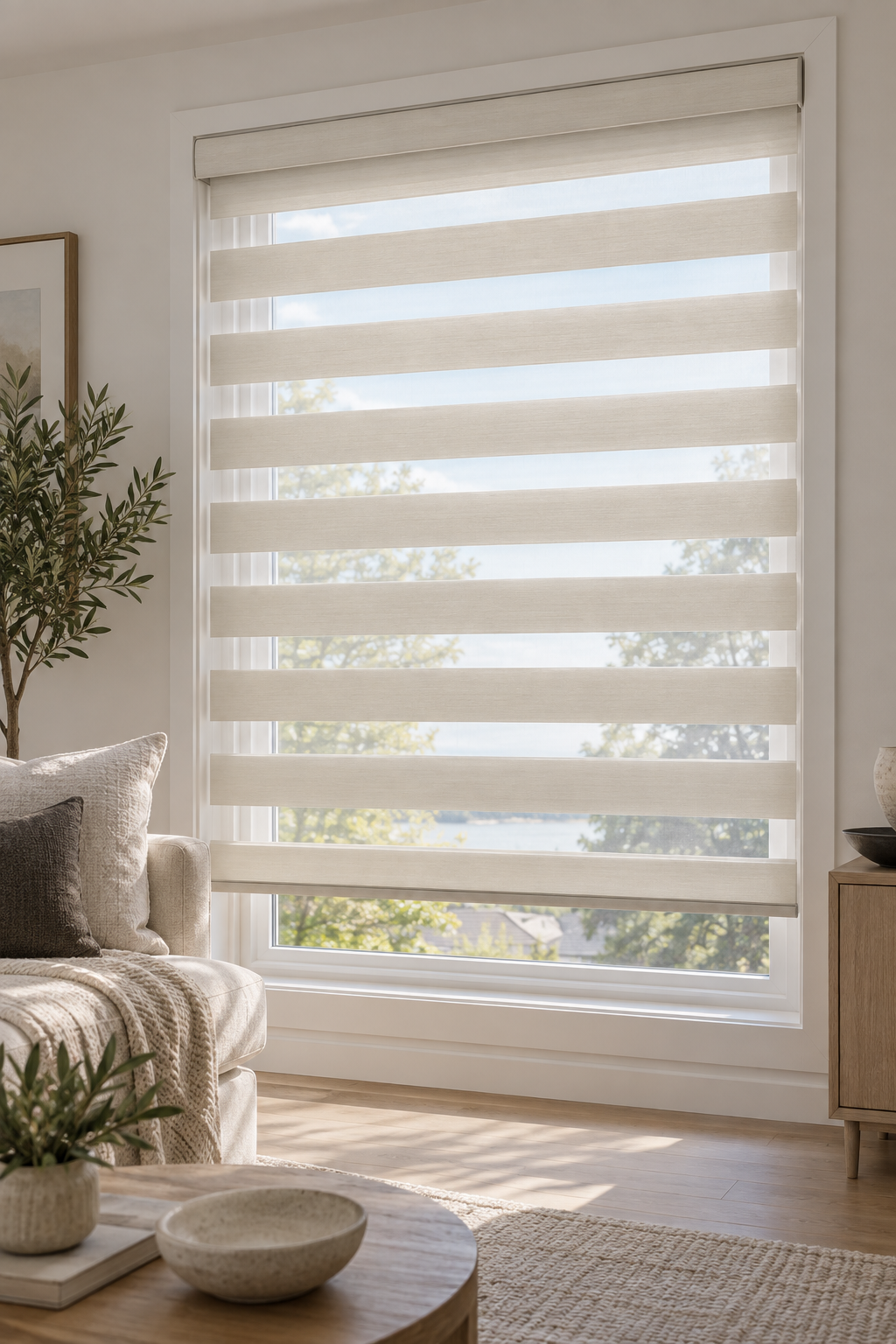
A darker bedroom depends on more than choosing a covering labelled “blackout.” Opacity, window coverage, mounting position, recess depth, trim, handles, installation, and gaps around the treatment all affect the result.
The right setup balances your main priority: maximum darkness, a streamlined appearance, design flexibility, improved comfort, or easier operation. This guide compares the options and explains what to confirm before ordering bedroom window treatments.
Quick summary

- Compare blackout roller blinds, blackout shades, cellular shades, and motorized options according to the bedroom and window configuration.
- Side, top, and bottom gaps can allow light into the room even when the material itself is highly opaque.
- Motorized blinds improve access and convenience, but do not automatically improve opacity or eliminate light leakage.
- For a child’s bedroom, consider cordless or motorized coverings without long accessible cords.
- Professional measurement helps account for recess depth, trim, handles, obstructions, mounting, and desired coverage.
Choose the blackout option around your bedroom’s main need
Start with the room’s purpose and the window’s constraints. A bedroom used for daytime sleeping may need stronger room darkening, while another may place equal importance on privacy, décor, or convenient access to daylight.
Blackout roller blinds, blackout shades, cellular shades, and motorized solutions can all be suitable, but they solve different parts of the problem. Compare blackout blind options before discussing exact fabrics, measurements, and mounting.
| Option | May suit | Main consideration |
|---|---|---|
| Blackout roller blinds | A clean, streamlined bedroom | Opacity, fit, mounting, and edge coverage affect darkness |
| Blackout shades | Bedrooms where colour and texture matter | Performance depends on product, fabric, coverage, and installation |
| Cellular or honeycomb shades | A structured appearance and added window comfort | The cellular structure alone does not guarantee darkness |
| Motorized solutions | High, wide, or hard-to-reach windows | Motorization improves operation, not opacity or gap control |
Compare bedroom blackout window treatments

Blackout roller blinds
Blackout roller blinds use a single panel that rolls around a tube when raised and covers the glass when lowered. Their flat appearance can work well when the treatment should coordinate quietly with the room.
They are a useful starting point when stronger light control and a consistent appearance matter across several windows. However, the fabric panel is only one part of the result. The opening, mounting position, and surrounding gaps still require attention.
Blackout shades
Blackout shades offer a shade-based approach to room darkening while allowing more flexibility with colour, texture, and visual character. Ask how the selected shade, fabric, lining, coverage, and mounting will work together. A decorative appearance alone does not establish how private or dark the room will be.
Cellular shades
Cellular, or honeycomb, shades use a pocketed structure that creates space between the room and the glass. This may support window comfort and moderate heat transfer, but results vary with fit, window condition, sun exposure, room use, and operation.
They cannot replace damaged windows, air-sealing work, glazing improvements, or other building upgrades. Natural Resources Canada identifies glazing as a major determinant of window energy efficiency. Its guidance on window glazing provides useful context when energy performance is part of the decision.
Motorized blinds
Motorized blinds can be worthwhile when a bedroom window is high, wide, difficult to reach, or adjusted frequently. They make it easier to open and close the covering without stretching or moving furniture.
Keep the decisions separate: motorization addresses access and convenience, while opacity, coverage, mounting, and fit address light control. A motorized covering is not automatically a blackout covering.
Why opacity, fit, and light gaps matter
“Blackout” generally indicates that the selected material is intended to limit incoming light more effectively than a light-filtering covering. It does not guarantee complete darkness. Light can enter at the sides, top, or bottom if the covering does not suit the window or the mounting position leaves exposed areas.
When comparing blackout roller blinds, ask about more than fabric opacity. Window construction, frame depth, trim, handles, obstructions, mounting position, and installation all influence the result.
- Opacity: Confirm whether the material is intended for room darkening.
- Side coverage: Check for visible gaps between the treatment and frame.
- Top coverage: Consider whether trim or mounting creates a path for daylight.
- Bottom coverage: Account for the sill, handles, furniture, and lowered position.
- Window constraints: Note recess depth, shallow openings, unusual shapes, and nearby obstructions.
Inside mount or outside mount?
An inside mount places the covering within the recess. An outside mount positions it over the opening or surrounding area. Neither is automatically best. The choice depends on available depth, trim, handles, obstructions, desired appearance, and the amount of edge coverage required.
Inside mount
An inside mount can preserve the window’s lines and create an integrated appearance when the recess has adequate depth. Handles, trim, hardware, and uneven surfaces must be checked carefully because they can affect operation and fit.
Outside mount
An outside mount may be worth discussing when the recess is shallow, the window has obstructions, or broader coverage is important. It changes the visual scale of the treatment and requires consideration of nearby walls, trim, furniture, and access.
Ask the installer to compare both approaches at the actual window. The goal is to balance appearance, operation, access, and control of side, top, and bottom light gaps.
Privacy, comfort, and energy considerations
Bedroom shades can support privacy, glare control, and a more comfortable room, particularly where the window faces a bright exterior area or receives direct sun. Cellular shades may contribute to window comfort, but cannot correct a failed seal, damaged frame, or significant air leakage.
Avoid choosing a covering on the assumption that it will deliver a specific energy saving or replace an improvement to the window itself.
Bedroom window-covering safety in Canada
Safety deserves particular attention in children’s bedrooms and nurseries. Health Canada states that its window-covering requirements apply to custom-made and off-the-shelf products, and identifies coverings without long accessible cords as the safest option where children are present. Review the Health Canada guidance on window-covering cord safety before ordering.
Ask about cordless or motorized operation and everyday control access. Canadian requirements also restrict reachable cord lengths and loop sizes, so confirm that the proposed covering meets applicable requirements. Further details appear in Health Canada’s safety requirements.
Bedroom blackout shade measurement checklist
Before requesting a quote, note what the bedroom needs to do and what may restrict installation. Professional measurement can then address the actual window rather than relying on standard sizes.
- Which matters most: darkness, privacy, glare reduction, appearance, comfort, or access?
- Is the window recessed, surrounded by trim, next to a door, or fitted with interfering handles?
- What are the recess depth, opening dimensions, sill position, and unusual features?
- Would inside or outside mounting provide better fit and edge coverage?
- Where could side, top, or bottom gaps allow unwanted light?
- Does the room require cordless or motorized control?
- Which fabric, opacity, colour, and care requirements suit the room?
- How will the treatment operate beside furniture, curtains, doors, and other features?
Lavish Blinds provides made-to-measure blinds, shades, and shutters with personalized design guidance, free on-site measurement and quotes, and professional installation. Its services include blackout shades, roller blinds, cellular shades, and remote-controlled or automated options.
A simple decision path
- Define the goal. Decide whether the priority is darkness, privacy, décor, comfort, or operation.
- Assess the window. Check recess depth, trim, handles, obstructions, access, and likely light-leakage routes.
- Compare categories. Start with roller blinds for a flat profile, shades for design flexibility, cellular shades for a structured comfort-focused option, or motorized blinds for difficult access.
- Choose the mounting approach. Compare inside and outside mounting at the actual window.
- Confirm safety and installation. For child bedrooms, prioritize an appropriate cordless or motorized arrangement and professional fitting.
If you are preparing a bedroom for real-estate photography, controlling daylight and keeping the room visually consistent can help present the space. Planning the best time for real-estate photos alongside the window-covering setup can help you use available light effectively.
Frequently asked questions
Can blackout shades make a bedroom completely dark?
They can substantially limit incoming light, but complete darkness is not guaranteed. Opacity, coverage, mounting, trim, handles, and gaps all affect the final result.
Are motorized blinds better for blackout performance?
Not automatically. Motorization improves access and convenience. Blackout performance still depends on opacity, fit, coverage, mounting, and installation.
Should blackout shades be mounted inside or outside the recess?
It depends on recess depth, trim, handles, obstructions, appearance, and desired edge coverage. Compare both approaches at the actual window.
Are cellular shades suitable for bedrooms?
They may be suitable when their appearance and comfort benefits fit the room. The cellular structure alone does not guarantee complete darkness.
What should parents check for a child’s bedroom?
Check that the covering meets Canadian requirements and avoid long accessible cords where possible. Discuss cordless or motorized operation, control access, and professional installation.
Optimize the whole window-covering setup
The most effective bedroom blackout solution is not selected by the label alone. Choose the category around the room’s main need, then confirm opacity, coverage, mounting, recess conditions, edge gaps, operation, privacy, and safety.
For homeowners in Oakville and the Greater Toronto Area, Lavish Blinds provides made-to-measure blinds, shades, and shutters, personalized design guidance, free on-site measurement and quotes, and professional installation.